
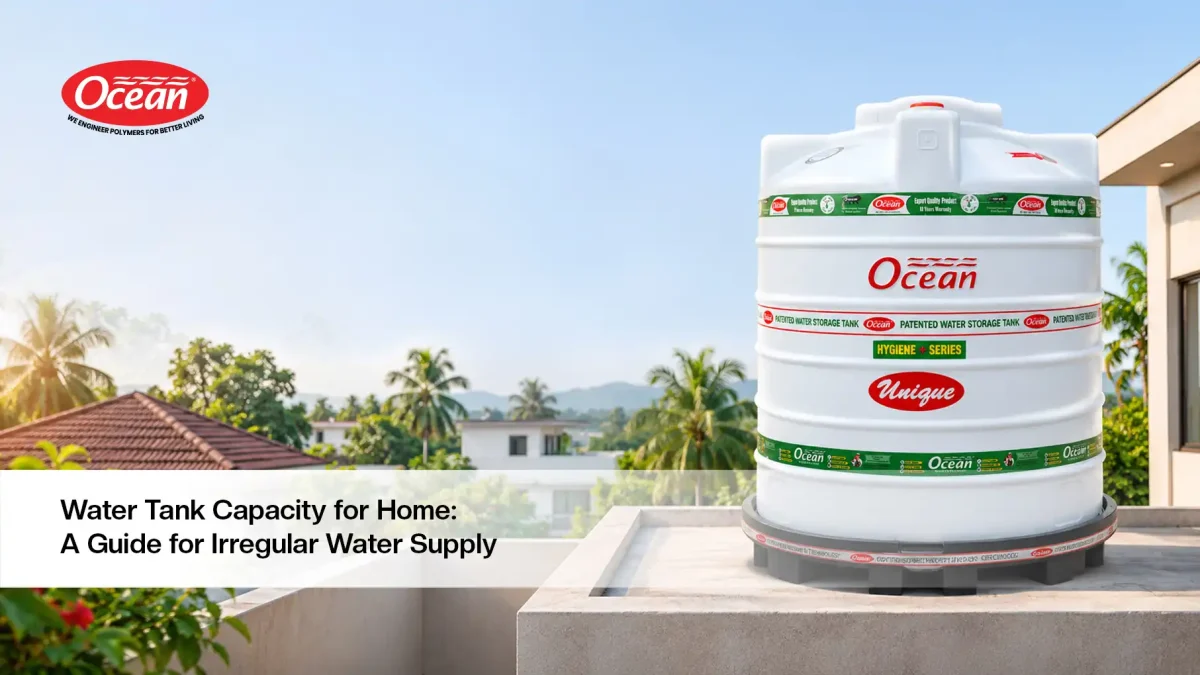
For many households in Kerala and Tamil Nadu, the real question is not just how much water the family uses. It is when the next supply will arrive. Municipal water may come every other day, wells can run low in summer, and some homes rely on tankers when everything else fails.
In these situations, the right water tank capacity for home use can make daily life far easier. But bigger is not always better. A tank that is too large can leave water sitting unused for too long, while one that is too small runs dry before the next supply. This guide walks you through a simple way to work out the right size and set up your storage sensibly.
Quick Answer: How Do You Calculate Water Tank Capacity for Home Use?
Multiply your household’s daily water use by the number of days between supplies, then add a small reserve for delays. For example, a home using 600 litres a day with a two-day supply gap needs about 1,200 litres, plus a reserve. Then check the space available, your water sources and how easily the tank can be cleaned.
Step 1: Estimate How Much Water Your Home Uses Each Day
Start with your everyday use, not the tank size.
As a planning guide, the Indian Standard for water supply in buildings (IS 1172) uses 150 to 200 litres per person per day for urban homes with flushing toilets, and 135 litres per person per day for smaller households. Actual use varies from home to home, so treat these numbers as a starting point.
| People at home | At 135 litres per person | At 200 litres per person |
| 2 | 270 litres a day | 400 litres a day |
| 4 | 540 litres a day | 800 litres a day |
| 6 | 810 litres a day | 1,200 litres a day |
Adjust for your habits. Extra bathrooms, a washing machine used daily, a garden or guests staying often will all push your use towards the higher end.
Step 2: Work Out Your Supply Gap
Next, look at how often water actually arrives, not how often it is supposed to.
- Daily supply with occasional breaks: plan for one day of use plus a small reserve
- Alternate-day supply: plan for two days of use
- Supply every two to three days: plan for three days of use
- Tanker-dependent: plan around the usual gap between deliveries
Think about the worst normal month, not the best. In many homes, summer shortages and repair work stretch the gap longer than usual.
Step 3: Add a Sensible Reserve
A reserve covers a delayed supply or a tanker that does not turn up. For most homes, an extra half-day to one day of water is a practical buffer.
The simple formula:
Daily use × days between supplies + reserve = storage you need
Example: A family of four uses about 600 litres a day and receives water every other day.
- 600 × 2 = 1,200 litres
- Reserve of about 300 litres
- Total: about 1,500 litres
Should You Choose One Large Tank or Two Smaller Tanks?
Both can work. The right choice depends on your space and how you want to manage cleaning.
| Factor | One large tank | Two or more smaller tanks |
| Space needed | One strong, open location | Fits into separate spaces |
| Cleaning | Water supply stops while cleaning | Clean one while using the other |
| Upkeep | Fewer tanks to check | More tanks and fittings to inspect |
| Plumbing | Simpler connections | Extra connections needed |
If you have one good spot on the terrace, a single tank is often simpler. If space is limited or you want backup during cleaning, two tanks can be more practical.
How Does a Sump and Overhead Tank System Work?
Many homes with irregular or low-pressure supply use a two-tank setup:
- Water is collected in a sump or ground-level tank whenever supply arrives.
- A pump lifts the water to an overhead tank.
- The overhead tank supplies the house through gravity.
This setup is useful when municipal pressure is too low to reach the roof, or when water arrives at inconvenient hours. Plan both tanks together: the sump should hold enough to refill the overhead tank, and the overhead tank should cover a day’s use or more.
Before installing an overhead tank, check that the roof or stand can safely support its full weight. One litre of water weighs about one kilogram, so a 1,000-litre tank weighs about a tonne when full.
How Do You Keep Stored Water Safe?
When supply is irregular, water often stays in the tank longer. That makes good habits important.
- Keep the lid closed and secure at all times.
- Stop dust, leaves and insects from getting in through gaps or open inlets.
- Use the oldest water first so stored water keeps moving.
- Clean the tank regularly, following the manufacturer’s care guidance.
- Watch for changes in colour, smell or sediment.
Mixing water sources? Municipal, well, borewell and tanker water can differ in quality. Think about what each source will be used for, and get the water tested if you have concerns about drinking it.
How Can You Make Stored Water Last Longer?
Small changes help stored water stretch further between supplies.
- Fix dripping taps and leaking pipes quickly.
- Run washing machines only with full loads.
- Keep an eye on the tank level during long gaps.
- Plan heavy cleaning for days when supply is due.
- Put drinking, cooking and hygiene first when water is low.
What Mistakes Should You Avoid?
- Buying the biggest tank available. Oversized tanks can leave water standing unused for long periods.
- Buying too small. A tank that empties before the next supply defeats the purpose.
- Ignoring access. A tank that is hard to reach is a tank that rarely gets cleaned.
- Forgetting the future. A growing family or an extra bathroom will raise your daily use. Leave room to add a second tank later.
Choosing the Right Tank From Ocean Group
Once you know your capacity, choose a tank that suits your space and setup. Ocean Group, a Thrissur-based water tank manufacturer with 27+ years of experience, offers water storage solutions for homes across Kerala, Tamil Nadu and South India.
- Rooftop storage: Ocean ISI, Ocean Super and Ocean 2, 3 and 4 Layer tanks
- Limited space: Ocean Loft and Ocean Capsule tanks
- Vertical storage: Ocean Sump Vertical
- Larger needs: stainless steel and high-capacity steel tanks
Residential tanks are available from 500 to 5,000 litres. Industrial and commercial tanks go up to 20,000 litres or more. Ocean tanks feature food-grade, non-toxic interiors and UV-stabilised, weather-resistant construction, and ISI-certified options are available.
Key Takeaways
- Start with daily use, then multiply by your supply gap.
- Add a reserve of about half a day to one day.
- Bigger is not always better. Avoid water sitting unused.
- Consider a sump and overhead tank system for low or irregular supply.
- Keep tanks covered, cleaned and easy to reach.
Plan Once, Worry Less
An irregular water supply does not have to mean daily stress. With the right water tank capacity for home use, a sensible reserve and a few good habits, your household can stay comfortable between supplies.
Need help choosing the right size? Find your nearest Ocean distributor or contact Ocean Group for advice on the right tank for your home.
FAQs
-
What size water tank does a family of four need?
A family of four typically uses about 540 to 800 litres a day, based on IS 1172 planning figures. With daily supply, a 1,000-litre tank usually works. With alternate-day supply, plan for around 1,500 to 2,000 litres, including a reserve.
-
How do I calculate water tank capacity for my home?
Multiply your daily water use by the number of days between supplies, then add a reserve of half a day to one day. For example, 600 litres a day with a two-day gap needs about 1,500 litres in total.
-
Is a bigger water tank always better?
No. An oversized tank can leave water sitting unused for long periods, which is not ideal for stored water. Choose a capacity that matches your daily use and supply gap, with a sensible reserve.
-
Do I need both a sump and an overhead tank?
A sump and overhead tank system helps when municipal water pressure is too low to reach the roof or supply arrives at odd hours. The sump collects water, and a pump lifts it to the overhead tank for daily use.
-
Which water tanks does Ocean Group offer for homes?
Ocean Group offers rooftop tanks including Ocean ISI, Ocean Super and multi-layer models, loft and capsule tanks for compact spaces, the Ocean Sump Vertical, and steel tanks. Residential tanks range from 500 to 5,000 litres.