
Flooring, roofing, doors and windows get most of the attention when you plan a home. The door frame matters just as much. It carries the weight of the door, holds the hinges and lock in place, and has to stay straight through years of daily use. In Kerala, with its heavy monsoons and high humidity, the frame material can decide whether your doors work smoothly or cause trouble within a few years. This guide explains how to choose the best WPC door frames for Kerala homes, how they compare with wood and metal, and why the way a frame is made matters as much as the material.
Key Takeaways
- Kerala’s monsoon, humidity and coastal air make moisture and termite resistance the top priorities.
- WPC frames suit bathrooms, kitchens, coastal homes and other damp locations.
- Extruded WPC profiles, made in one continuous piece, avoid the joints and weak seams found in sheet-based products.
- Check density, screw-holding strength and profile size, not just the finish.
- Ask for test documentation. Claims such as “waterproof” mean little without it.
Why Door-Frame Selection Matters During Construction
A door frame is a structural component. Its dimensions, strength and fixing method decide how well the door opens, closes and holds its alignment. Choosing it at the planning stage lets your architect and contractor coordinate wall thickness, door size and installation sequence, and avoids last-minute changes that delay the schedule.
Location matters too. A bathroom entrance faces far more moisture than a bedroom entrance, so match the material to each location instead of using one material everywhere.
How Kerala’s Climate Affects Door Frames
Kerala has long monsoon seasons and humidity throughout the year, and coastal homes also face salt-laden air. Timber absorbs moisture depending on its species, seasoning and treatment, and repeated wet and dry cycles can cause swelling, warping and decay. Metal frames depend on their protective coating, and a damaged coating can lead to corrosion. Termites are a constant concern for untreated timber.
So the real question is not whether a material is labelled “weather-resistant”. It is how the product performs in your conditions and how much upkeep it needs.
Six Factors to Check Before Selecting a Door Frame
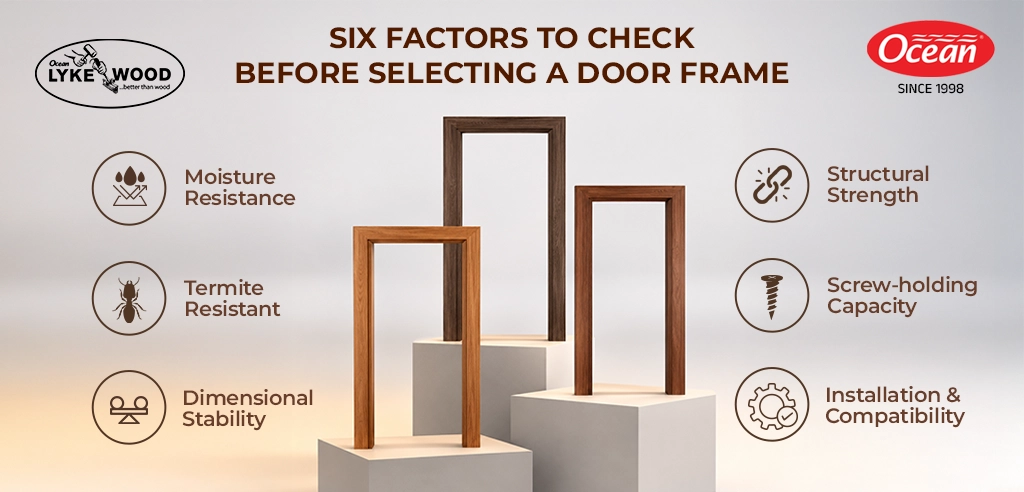
- Moisture resistance: How does it perform in bathrooms, kitchens and wash areas?
- Termite resistance: Is it naturally resistant, or does it need repeated treatment?
- Dimensional stability: Will it hold its shape through monsoon and summer?
- Structural strength: Can the profile carry your door through daily use?
- Screw-holding capacity: Hinges and locks are only as secure as the material holding the screws.
- Installation and compatibility: Confirm profile size, wall thickness, door weight and hardware before ordering.
Why WPC Door Frames Suit Kerala Homes
WPC is an engineered material made from wood-based components, thermoplastic polymers and additives, moulded into profiles for door frames, window frames and other building uses. Unlike natural timber, it is designed to resist moisture and termite damage. For Kerala homes, that means less worry about swelling, warping and rot, no dependence on repeated anti-termite treatment, and no regular polishing or re-coating.
For bathrooms, kitchens, coastal homes and other damp areas, a well-made WPC frame is usually the safer, lower-maintenance choice compared with untreated timber. The words “well-made” matter, because performance depends on formulation, manufacturing process and profile design.
WPC vs Wooden vs Metal Door Frames
| Factor | Wooden | WPC | Metal |
| Humid conditions | Depends on timber quality, seasoning and protection | Designed for moisture resistance; formulation matters | Needs good corrosion protection |
| Termites | May need preventive treatment | Generally resistant | Not susceptible |
| Maintenance | Periodic polishing or coatings | Generally low surface maintenance | Coating needs monitoring |
| Installation | Needs accurate carpentry | Follows manufacturer’s fixing instructions | Needs proper anchoring |
For damp and termite-prone areas in Kerala, a good WPC frame is usually the more practical choice. Seasoned, well-treated timber can still suit dry interiors, and metal suits specific structural needs.
Extrusion vs Sheet Joining: Why the Manufacturing Method Matters
Two WPC products can look identical on the surface and still perform very differently, depending on how they are made. There are two common approaches.
Sheet-based products. Some manufacturers cut WPC sheets and join them with adhesives or fasteners to build frames and doors. This has real drawbacks:
- Every joint is a potential weak point where moisture can seep in over time.
- Glued seams may separate with repeated humidity and temperature cycles.
- Strength and screw-holding can vary from one section to another.
- Cut edges and seams may need extra sealing, and finish quality depends on the workmanship of the joining.
Extrusion technology. Ocean Lykewood makes its WPC products by extrusion. The material is melted and pushed through a shaped die, forming a continuous profile in a single process. There is no sheet joining at all. The advantages are:
- No joints or seams within the profile, so there are no glued lines to open up.
- Consistent cross-section, giving accurate dimensions that make installation easier.
- Uniform material distribution, which supports reliable strength and screw-holding.
- Better moisture performance, since there are no seams for water to enter.
- Repeatable quality across batches, because the process is controlled and continuous.
When comparing suppliers, ask whether the frame is extruded as a single profile or assembled from joined sheets. The answer says a lot about how it will age in Kerala’s climate.
Two Shutter Types to Match Your Design
Frames are only half the picture, so Ocean Lykewood also offers two types of shutters:
- Grooved shutters: The shutter fits into a groove in the frame, giving a clean, integrated look and a snug fit.
- Customary-model shutters, fixed through reaper: This follows the traditional method, where the shutter is fixed to the frame with a reaper (batten), the style many Kerala carpenters and homeowners know well.
Both are made with the same extrusion process, so you can choose the style that suits your design and your contractor’s preferred fixing method.
Density and Screw-Holding Capacity
Density shows how much material is packed into the profile, but density alone does not guarantee performance. Profile geometry, material distribution and consistency across batches also matter.
Screw-holding deserves special attention. Hinges carry repeated loads every time the door moves, and if the frame cannot grip screws firmly, hinges loosen and the door starts to sag.
What Do the CIPET Test Results Tell Buyers?
A test report from CIPET (Institute of Plastics Technology), Kochi, recorded the following for the submitted WPC sample:
- Water absorption: 0.073% after 2 hours and 0.217% after 24 hours
- Screw withdrawal strength: 2,168 N for the tested face
These are very low water absorption and strong screw-holding for the tested sample, which is what matters in humid conditions and for hinge-heavy doors. The results apply to the sample and test method used, not to every profile or batch, so when comparing any supplier, check which product and method each result refers to.
Questions to Ask Before Buying
- Which profile suits my door size and wall thickness?
- Is the product extruded as one profile, or built from joined sheets?
- What are the density, strength and screw-holding figures?
- Are moisture and termite claims backed by test documents?
- Which shutter type and fixing method are recommended?
- What maintenance and warranty terms apply?
WPC Door Frame Price in Kerala
Price depends on profile size (a 100 × 65 mm profile uses more material than a 65 × 32 mm one), density, length, quantity, finish and accessories. The most accurate way to get pricing is to share your door sizes and quantities and request a quote.
Start Your Home Project with the Right WPC Frames
Building a home in Kerala requires careful attention to materials that can withstand changing weather conditions and everyday use. From selecting the right frame profile to choosing a suitable shutter design, every detail contributes to the durability and functionality of your doors.
Ocean Lykewood offers extruded WPC door frames, WPC doors and window frames designed to meet the needs of modern homes. Whether you are constructing a new house or planning a renovation, explore our range of WPC solutions and discuss your requirements with our team. Get in touch with Ocean Lykewood to find the right products for your home.
FAQs
-
What are WPC window shutters made of?
The WPC manufacturing process involves combining wood-based components, thermoplastic polymers and suitable additives to create a composite material. The material is then processed into the required product using manufacturing methods such as extrusion or sheet-based fabrication.
-
How does direct extrusion technology improve WPC door and window frame manufacturing?
Direct extrusion shapes WPC material into the required door and window frame profiles without joining multiple sheets. It can reduce additional fabrication and labour requirements. Proper material formulation and extrusion control also help maintain density, strength and dimensional accuracy.
-
3. What are the different types of WPC window shutters offered by Ocean Lykewood?
Ocean Lykewood offers two types of WPC window shutters. The first is a grooved model designed to accommodate 6 mm glass. The second is a customary model in which the shutter is fixed using a reaper. Both are manufactured using specially designed extruded profiles.
-
How are Ocean Lykewood window shutters different from conventional sheet-based shutters?
Conventional sheet-based window shutters commonly use WPC door sheets for fabrication. Ocean Lykewood uses specially designed extruded profiles to manufacture its window shutters. This approach forms the shutter profiles according to their intended design requirements.
-
What should buyers consider when choosing a WPC manufacturer in Kerala?
Buyers should examine manufacturing technology, material formulation, profile design, density information and available technical specifications. For window shutters, they should also understand the available shutter models, glass groove dimensions and fixing methods. Product suitability for Kerala’s humidity and monsoon conditions should also be considered.