
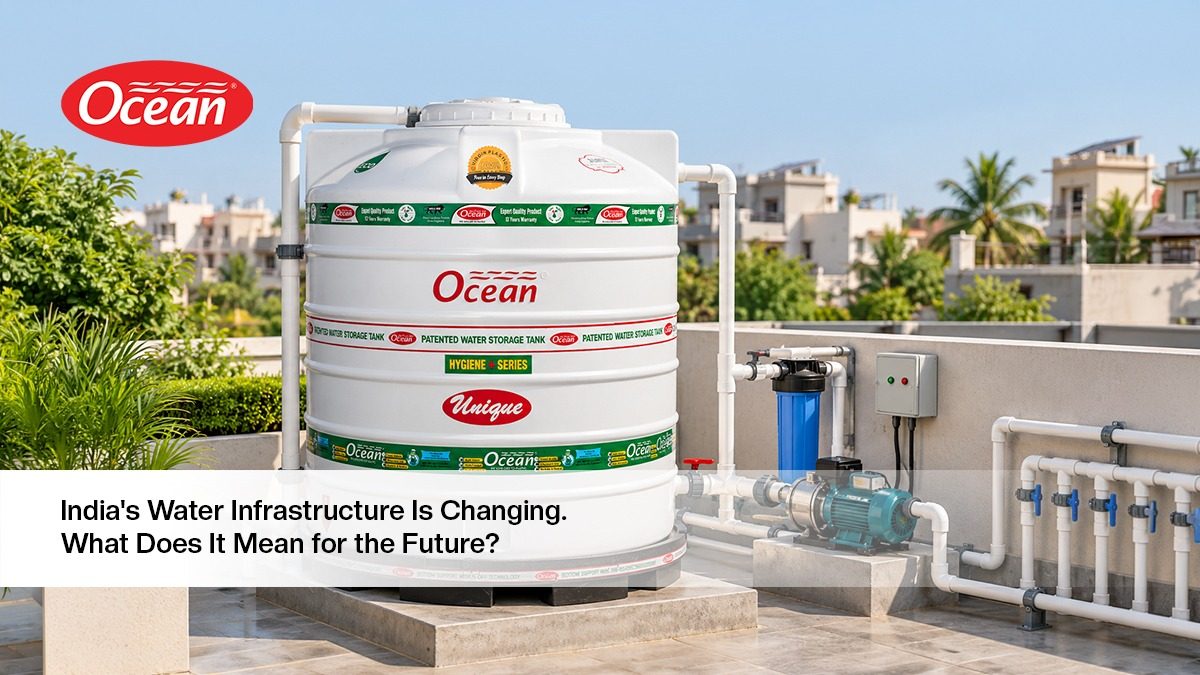
Water infrastructure in India is no longer simply about building more pipelines, reservoirs, and storage tanks. As cities expand, rural connectivity improves, water demand rises, and freshwater resources come under greater pressure, the way India manages, stores, distributes, treats, and reuses water is changing as well. From household tap connections to large-scale treatment plants, the country’s water systems are gradually moving towards a more connected and sustainable approach.
Government programmes such as Jal Jeevan Mission and AMRUT 2.0 are placing greater emphasis on reliable water supply, source sustainability, water-body rejuvenation, wastewater treatment, and reuse. In March 2026, the Union Cabinet extended Jal Jeevan Mission until December 2028 through a restructured framework known as JJM 2.0, with a stronger focus on reliable and sustainable rural drinking water services rather than infrastructure creation alone.
For households, businesses, industries, and infrastructure developers, this shift has an important implication: water storage and supply systems can no longer be treated as secondary components. They are becoming an increasingly important part of how communities prepare for the future.
Why India’s Water Infrastructure Needs to Evolve
India’s water requirements are changing alongside its population, urbanisation, industrial activity, and patterns of development. A growing city needs more than a source of water. It needs systems capable of treating that water, storing it safely, distributing it efficiently, managing wastewater, and protecting water sources for the years ahead.
This is one reason national urban water programmes are increasingly looking beyond basic supply infrastructure. AMRUT 2.0, for example, is designed around water-secure cities and includes functional tap connections, water-source conservation, rejuvenation of water bodies and wells, rainwater harvesting, and recycling and reuse of treated used water.
The change is therefore not about replacing one type of infrastructure with another. It is about creating a more complete water cycle, where storage, supply, treatment, reuse, and conservation work together.
From Access to Reliable Water Supply
One of the most visible changes in India’s water infrastructure has been the expansion of household tap-water access, particularly in rural areas.
The Jal Jeevan Mission has significantly expanded rural household tap-water connections since its launch. With JJM 2.0 now extending the programme to December 2028, the emphasis is shifting further towards service delivery, long-term sustainability, asset management, and reliable drinking-water systems.
For a household, however, having a connection is only one part of having dependable water access. The water still needs to be available when required, stored safely where necessary, and distributed through a system that can perform consistently.
This is where storage infrastructure becomes increasingly relevant. Properly designed tanks and storage systems can help bridge the gap between water availability and household or institutional demand, particularly where supply is intermittent or varies by season.
Storage Is Becoming More Important, Not Less
As water infrastructure becomes more sophisticated, it may seem that the role of a water tank should become smaller. In reality, reliable storage remains an essential part of the system.
A well-designed storage tank provides a controlled point between supply and consumption. For homes, it can ensure water is available for everyday needs. For apartments and institutions, larger storage systems help manage demand across multiple users. For industrial applications, specialised storage solutions can support operational requirements where water availability and continuity are critical.
The future of water infrastructure therefore does not eliminate storage. It raises the standards expected from it.
Materials, construction quality, hygiene, UV resistance, capacity, installation, maintenance, and suitability for the intended application all become important considerations when a tank is expected to remain part of a water system for many years.
Urban Water Systems Are Becoming More Integrated
India’s cities are also moving towards more integrated approaches to water supply and wastewater management.
AMRUT 2.0 includes projects covering water-supply networks, sewerage and septage management, water-body rejuvenation, and reuse of treated wastewater. Its operational guidelines specifically identify recycling and reuse of treated used water and rainwater harvesting as part of the broader objective of making cities more water secure.
Projects already approved under the programme demonstrate how these ideas are translating into infrastructure on the ground. They include 24×7 water-supply schemes, upgraded distribution networks, sewage-treatment plants, treated-water reuse projects, and rejuvenation of urban water bodies across different cities.
This points towards a future where water infrastructure is increasingly viewed as a connected network rather than a series of independent components.
Wastewater Is Becoming Part of the Water Conversation
Traditionally, conversations about water focused mainly on finding, treating, storing, and supplying fresh water. That approach is gradually expanding to include what happens after water has been used.
Wastewater treatment and reuse are becoming increasingly important as cities and industries look for ways to reduce pressure on freshwater resources. The Ministry of Jal Shakti stated in March 2026 that safe reuse of treated water is emerging as a national priority, with efforts focused on applications including power, agriculture, and industry.
This does not mean treated wastewater will replace freshwater for every application. Different uses require different quality standards and treatment processes. What is changing is the understanding that water that has already been used does not necessarily have to become waste.
In a more circular water system, appropriately treated water can potentially be used again for suitable non-potable applications, reducing unnecessary demand on freshwater sources.
Water-Body Rejuvenation Is Part of the Bigger Picture
Infrastructure is not only about pipes, tanks, pumps, and treatment plants. Natural and community water bodies also form an important part of India’s water ecosystem.
AMRUT 2.0 includes rejuvenation of water bodies and wells as part of its approach to sustainable freshwater supply. Approved projects across cities include the restoration and rejuvenation of ponds, lakes, and other water bodies alongside conventional water-supply and sewerage infrastructure.
This broader approach recognises that long-term water security depends not only on distributing available water efficiently but also on protecting and strengthening the sources that support it.
For rapidly growing towns and cities, this becomes especially important. Development can increase demand for water while simultaneously placing pressure on natural drainage systems, groundwater, lakes, and other local sources.
What Does This Mean for Homes and Buildings?
Large national infrastructure programmes may seem far removed from an individual home, apartment, or commercial building. Yet their impact eventually reaches the systems people interact with every day.
As buildings become more dependent on reliable water management, developers, architects, facility managers, and homeowners need to consider storage and distribution as part of the overall building system rather than as an afterthought.
This can mean selecting the right tank capacity, using suitable materials, planning overflow and inlet systems properly, providing adequate structural support, and ensuring that stored water remains protected from contamination.
In larger residential developments, the considerations become even broader. Apartment communities may need multiple storage points, underground and overhead systems, pumping arrangements, and carefully planned distribution networks to meet varying demand.
What Should the Water Storage Solutions of Tomorrow Offer?
The changing water landscape also raises expectations from manufacturers. A water tank designed for today’s requirements may need to perform in an environment where temperature variations, intense sunlight, humidity, changing consumption patterns, and increasing emphasis on hygiene are all part of the equation.
Safe and Hygienic Storage
Water storage systems need to protect the quality of stored water. Food-grade materials, secure covers, smooth interiors, and appropriate construction can help reduce contamination risks and support hygienic storage.
Long-Term Durability
A storage system is expected to remain functional for years. UV-stabilised materials and robust construction can help tanks withstand prolonged exposure to India’s demanding climatic conditions.
Different Capacities and Applications
There is no single storage requirement for every user. A house, apartment complex, hospital, commercial building, institution, and industrial facility may all require different capacities and configurations.
Efficient Use of Space
As urban properties become more space-conscious, storage solutions also need to work within different architectural constraints. Overhead, underground, loft, vertical, and other specialised configurations can help accommodate different site requirements.
Materials Designed for the Application
The right material depends on where and how a product is being used. Residential water storage, industrial applications, sanitation infrastructure, and specialised systems can require different performance characteristics.
The Role of Manufacturers in India’s Water Future
As India’s water infrastructure develops, manufacturers have a role that extends beyond simply producing storage products. The quality of the materials, manufacturing processes, product design, testing, and after-sales support can all influence how effectively infrastructure performs over its intended lifespan.
Ocean Group has been manufacturing water tanks and polymer solutions in India for more than 27 years. Its product portfolio includes overhead and underground water tanks, loft and vertical sump solutions, steel and stainless steel tanks, water-supply products, industrial polymer products, WPC solutions, and waste-management and sanitation systems.
Ocean Group’s water-storage range uses one hundred per cent virgin, food-grade raw material and advanced roto-moulding technology, with ISI-certified products designed for safe and durable water storage. This combination of product variety and manufacturing experience reflects a broader reality in India’s infrastructure sector: future-ready water systems need products designed for different environments, applications, and levels of demand.
What the Future of Water Infrastructure Could Look Like
The next phase of India’s water infrastructure is unlikely to be defined by a single technology or solution. Instead, it is likely to involve several systems working together.
Water sources will need to be protected. Distribution networks will need to become more efficient. Storage systems will need to be dependable and hygienic. Wastewater treatment and reuse will become increasingly relevant in suitable applications. Digital tools and improved asset management can also help operators understand and maintain increasingly complex water networks.
The direction is already visible in national programmes. JJM 2.0 is placing greater emphasis on sustainable service delivery and asset management in rural water supply, while AMRUT 2.0 combines water supply with source conservation, water-body rejuvenation, sewerage management, rainwater harvesting, and treated-water reuse in urban areas.
The result could be a water infrastructure model that is less linear and more connected, where the focus is not simply on supplying more water but on managing every stage of the water cycle more responsibly.
Building for a Water-Secure Future
India’s water infrastructure is entering a period of gradual but significant change. The priorities are expanding from access and supply towards reliability, sustainability, storage, treatment, reuse, and long-term resource management.
For homes and businesses, this means that the systems supporting everyday water use deserve more attention than they often receive. A water tank may be one relatively small part of a much larger infrastructure network, but its role remains fundamental wherever water needs to be stored safely and reliably.
For manufacturers, the opportunity is equally clear. The future will demand products that are durable, hygienic, application-specific, and capable of supporting a changing water landscape.
With more than 27 years of experience in water storage and polymer solutions, Ocean Group continues to be part of this evolving infrastructure story, developing products for homes, industries, and infrastructure across South India.
The future of India’s water infrastructure will not be built around one solution. It will be built around better-connected solutions that make every drop count.
Frequently Asked Questions
-
Why is India’s water infrastructure changing?
India’s growing population, urbanisation, increasing water demand, and pressure on freshwater resources are creating a need for more integrated approaches to water supply, storage, treatment, conservation, and reuse. Government programmes such as Jal Jeevan Mission and AMRUT 2.0 reflect this broader approach.
-
What is the role of water tanks in modern water infrastructure?
Water tanks provide an important storage link between water supply and consumption. They can help homes, apartments, institutions, and businesses maintain access to stored water when supply is intermittent or demand varies.
-
Is wastewater reuse becoming more important in India?
Yes. Safe reuse of appropriately treated wastewater is receiving increasing policy attention as India seeks to strengthen water security and reduce pressure on freshwater resources. Applications can include suitable industrial, agricultural, and other non-potable uses depending on treatment quality and regulatory requirements.
-
What is AMRUT 2.0?
AMRUT 2.0 is an urban transformation programme of the Ministry of Housing and Urban Affairs focused on making Indian cities more water secure. Its objectives include water-supply coverage, sewerage and septage management, water-source conservation, water-body rejuvenation, rainwater harvesting, and recycling and reuse of treated water.
-
What is JJM 2.0?
JJM 2.0 refers to the restructured phase of the Jal Jeevan Mission, which was extended by the Union Cabinet in March 2026 until December 2028. The extended framework places greater emphasis on reliable service delivery and long-term sustainability of rural drinking-water systems.
-
What should I consider when choosing a water storage tank?
Consider the required capacity, installation location, material quality, UV resistance, hygiene, construction, available space, structural support, and the specific application. Choosing a product designed for the intended environment can help support reliable long-term storage.