
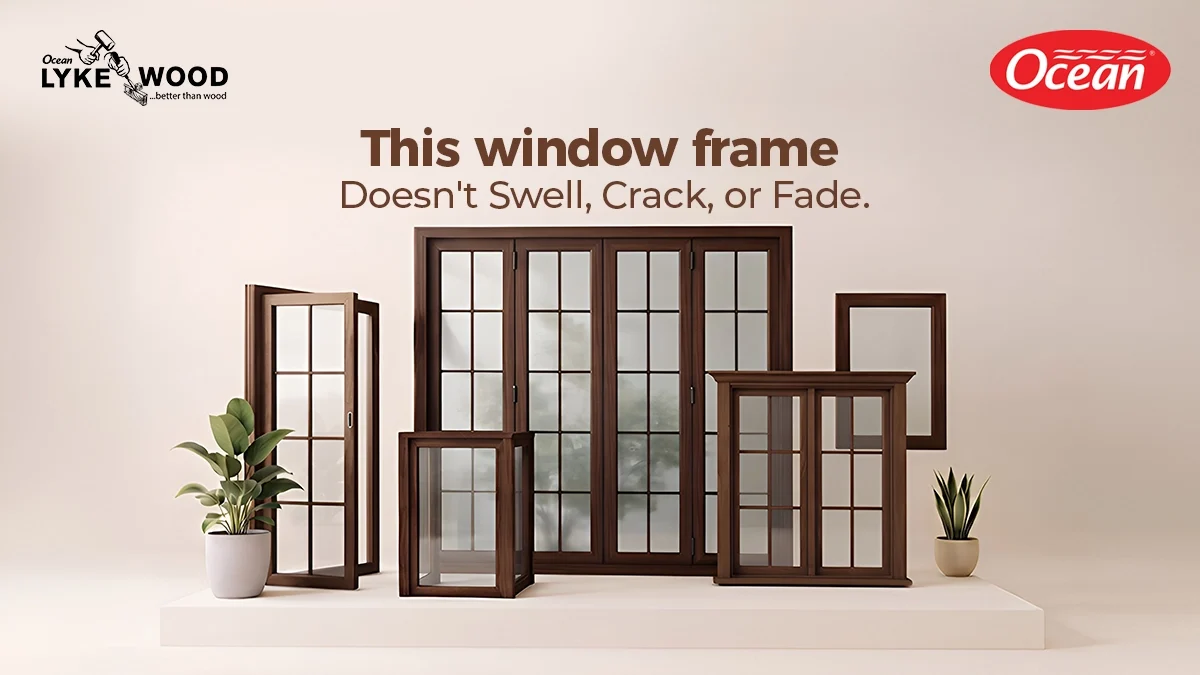
A window frame has to survive more than everyday use. In Kerala, it must handle monsoon rain, high humidity, strong sunlight, heat and termites for years. Traditional wood can absorb moisture and swell, while poor-quality materials may warp, crack, fade or require repeated maintenance.
The secret behind a durable wpc window frame is its material composition. Wood fibres are combined with polymers and performance-enhancing additives to create a frame with low moisture absorption, good dimensional stability and resistance to termites and everyday weather exposure.
A wpc window frame does not behave like natural wood because its polymer-based composition greatly limits moisture absorption. Quality WPC formulations can also include UV stabilizers and other additives that improve resistance to sunlight, termites and dimensional changes. This makes WPC a practical wood-alternative material for humid regions such as Kerala.
This article explains what WPC is, why it performs differently from wood, how it compares with uPVC and aluminium, and what buyers should check before choosing a frame.
What Is a WPC Window Frame?
WPC stands for Wood Plastic Composite. It is made by combining wood fibre or wood-based material with a polymer, along with additives that improve specific properties such as stability, colour retention and processing.
During manufacturing, the material is mixed and processed, commonly through an extrusion process. In simple terms, the WPC compound is heated and shaped into a consistent profile.
Unlike natural timber, WPC does not have the same porous structure that readily takes in water. The polymer forms a continuous matrix around the wood component, helping reduce moisture movement through the material.
That difference is important for window frames installed in bathrooms, coastal areas, kitchens and other moisture-prone locations.
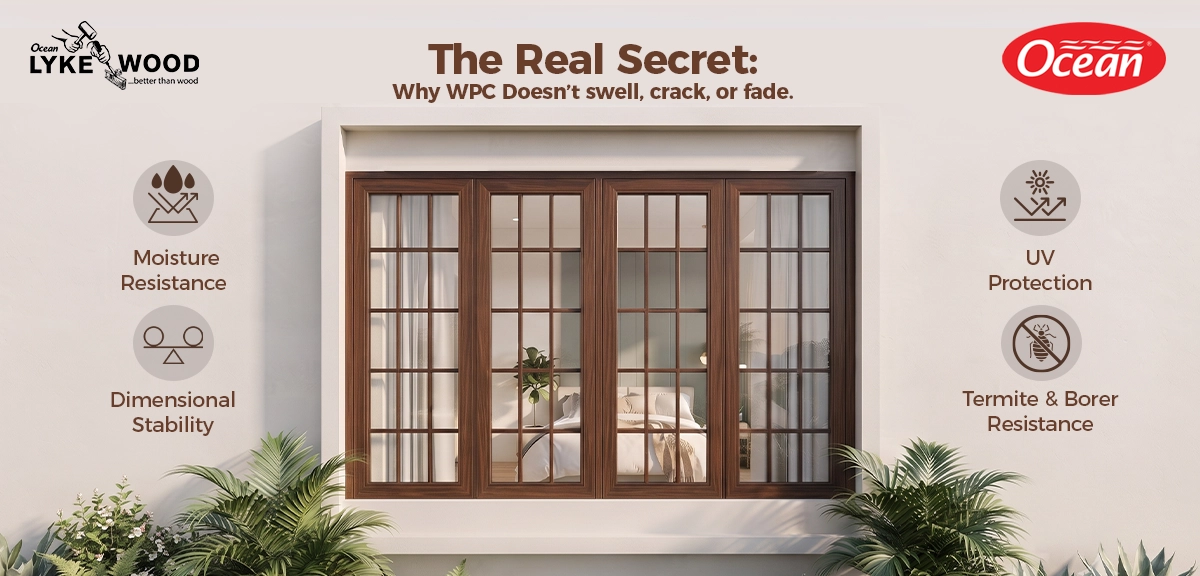
The Real Secret: Why WPC Doesn’t Swell, Crack, or Fade
1. Moisture Resistance
Wood naturally responds to moisture. It absorbs and releases water as environmental conditions change, which can lead to swelling, shrinking, warping and surface damage over time.
A quality WPC formulation has much lower moisture absorption than untreated wood. This helps the frame maintain its shape during humid weather and monsoon exposure.
It does not mean every WPC product is completely immune to water-related problems. Product formulation, density, manufacturing quality and installation all matter.
2. Dimensional Stability
Kerala’s climate can move from intense humidity to heat and direct sunlight within a short period. Materials repeatedly exposed to these changes can expand and contract.
WPC offers better dimensional stability than ordinary wood because its polymer content limits moisture-driven movement. Correct manufacturing and installation further help the frame maintain its intended dimensions.
3. UV Protection
Continuous sunlight can gradually fade or degrade exposed materials. Quality WPC products may use UV-stabilized additives to slow colour fading and surface degradation.
The result is better colour retention than a material with no UV protection, although the actual performance depends on the formulation, finish and level of exposure.
4. Termite and Borer Resistance
Termites and wood-boring insects are a major concern with natural timber. WPC does not provide the same food source as untreated wood, making it naturally resistant to termite and borer attack.
For homeowners, that can mean fewer worries about hidden structural damage inside the frame.
Key Benefits of WPC Window Frames
- Resists moisture: Helps reduce swelling and warping in humid conditions.
- Supports long-term stability: Maintains its shape better under changing humidity.
- Termite resistant: Reduces the risk associated with wood-boring pests.
- Lower maintenance: Does not need regular wood staining, polishing or anti-termite treatment.
- Flexible appearance: Can be designed with finishes that suit modern and traditional interiors.
- Suitable for humid areas: A practical choice for Kerala climate windows.
- Wood-alternative performance: Provides a familiar frame aesthetic without many common timber-related problems.
WPC vs Traditional Materials
| Criteria | WPC Window Frames | Natural Wood | uPVC | Aluminium |
| Moisture Resistance | High | Low–Moderate | High | Very High |
| Termite Resistance | High | Low | High | Very High |
| Maintenance | Low | High | Low | Low |
| Lifspan | Long with quality installation | Depends on wood and upkeep | Long | Long |
| Cost | Moderate–High | Moderate–High | Moderate | Moderate–High |
| Eco-Friendliness | Depends on recycled/renewable content | Renewable= but resource-intensive | Polymer-based | Highly recyclable |
| Aesthetic Flexibility | High | Very High | Moderate | High |
The right choice depends on the building, budget, design and installation conditions. WPC is particularly attractive where the appearance of wood is desired alongside greater resistance to moisture and termites.
Why WPC Window Frames Are Ideal for Kerala’s Climate
Kerala combines high humidity, heavy seasonal rainfall and strong sunlight. That creates a demanding environment for building materials.
For wpc windows, moisture resistance is one of the biggest advantages. A frame that absorbs less water is less likely to experience the swelling and movement associated with untreated timber.
This is also why homeowners and professionals researching wpc brands in kerala should look beyond appearance. Density, formulation, extrusion quality, UV protection, profile design, finishing and installation support all influence real-world performance.
Ocean LykeWood develops WPC products with the requirements of the Indian market in mind. Local manufacturing knowledge is valuable because a frame intended for Kerala should be selected with humidity, monsoon exposure and long-term maintenance in mind—not just showroom appearance.
How to Choose the Right WPC Window Frame
- Check the material grade and density: A stronger, consistent profile is important for long-term use.
- Ask about formulation: Understand whether the product includes additives for UV and weather resistance.
- Review warranty terms: Check what is covered and for how long.
- Inspect finish options: Choose a finish suited to the amount of sunlight and the interior design.
- Evaluate installation support: Good material can still perform poorly if installation is incorrect.
- Ask about quality control: A reliable manufacturer should maintain consistency across profiles and batches.
- Compare the complete system: Consider frame, hardware, glass, sealing and installation rather than judging the frame alone.
Maintenance Tips
One reason homeowners choose WPC is its relatively simple upkeep. Regular dusting and cleaning with a mild solution are generally sufficient for normal indoor or sheltered applications. Avoid harsh chemicals and abrasive tools that may damage the surface finish.
Unlike traditional timber, a quality WPC frame does not normally require routine polishing, painting or anti-termite treatment simply to maintain basic performance.
Why Choose Ocean LykeWood?
Ocean LykeWood focuses on WPC manufacturing for doors, door frames, window frames, mullions and shutters. Its approach combines material selection, manufacturing control and product development suited to Indian building conditions.
For homeowners, architects and contractors, the important point is not simply choosing a WPC product. It is choosing a manufacturer that understands profile consistency, material behaviour and the demands placed on building products over years of use.
Choosing a Frame That Actually Lasts
The secret of a durable wpc window frame is not a temporary coating. It is the material itself: a carefully formulated combination of wood-based fibre, polymer and performance additives.
That composition helps reduce moisture absorption, improve dimensional stability, resist termites and support better colour retention. For Kerala homes exposed to humidity and monsoon weather, these properties make WPC a compelling alternative to traditional timber.
If you are comparing window frames for a new home, renovation or project, explore Ocean LykeWood’s WPC window frame range and choose a solution based on material quality, installation and long-term performance.
FAQs
-
What is a WPC window frame made of?
A WPC window frame is made from a combination of wood fibre or wood-based material, polymer and selected performance additives. The formulation is processed into a stable profile, commonly through extrusion.
-
How long do WPC window frames last?
A quality WPC frame can provide long service life when properly manufactured, installed and maintained. Actual lifespan depends on formulation, exposure, installation quality and usage conditions, so buyers should always check the manufacturer’s warranty and specifications.
-
Does WPC window frame installation require any special care?
Yes. While WPC is more forgiving than natural wood, correct installation and sealing still matter for long-term performance. Poor installation can affect how well the frame resists moisture and maintains its shape, so it’s best to rely on a manufacturer with proper installation support rather than treating the frame as a standalone product.
-
Are WPC window frames expensive to maintain?
No. WPC generally requires less routine maintenance than natural wood because it does not normally need regular polishing, painting or anti-termite treatment. Basic cleaning is usually sufficient for normal use.
-
Are WPC windows suitable for Kerala’s monsoon climate?
Yes, quality WPC windows are well suited to humid and monsoon-prone environments because the material has low moisture absorption and good dimensional stability. Product quality, correct installation and suitable sealing remain important for long-term performance.