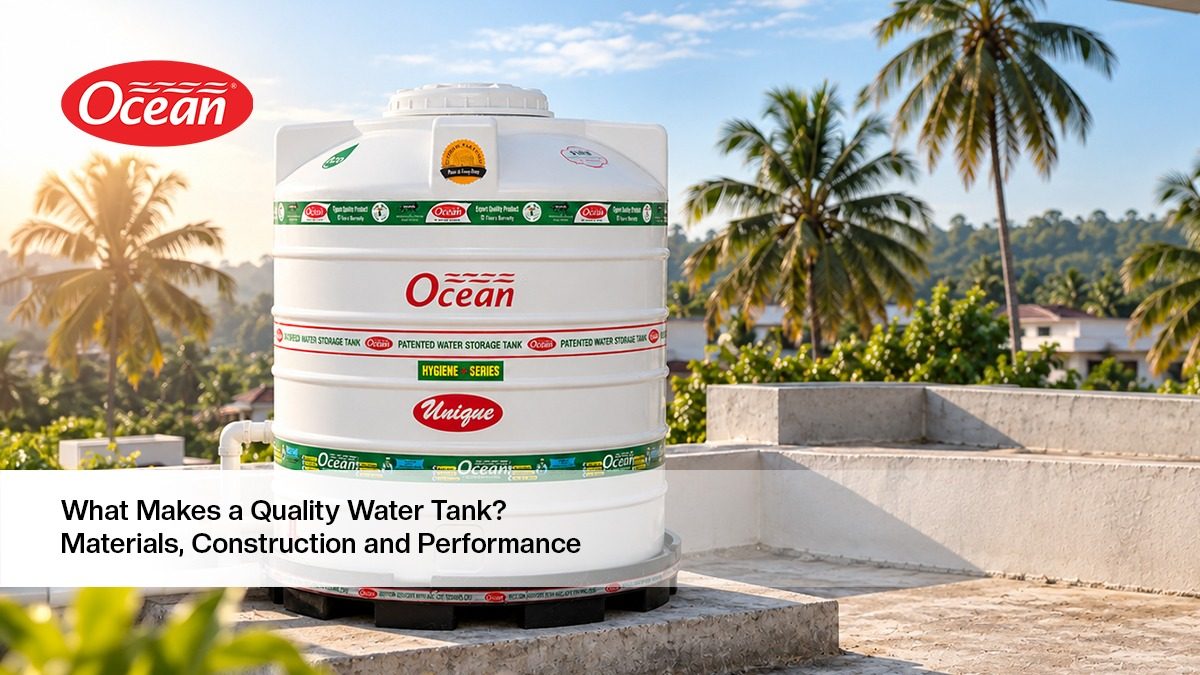
A water tank may look like a simple storage product, but its suitability depends on several factors that are not always visible from the outside. The material, construction, design, and manufacturing process all influence whether a tank meets the requirements of a particular installation.
For homeowners, builders, and commercial property owners, selecting a water tank involves more than choosing a capacity or comparing prices. The tank must be appropriate for its intended use, the available installation space, and the conditions in which it will operate.
Understanding what contributes to water tank quality can help buyers make more informed decisions. It also provides a useful starting point when comparing Ocean Water Tanks with other products available in the market.
Why Does Water Tank Quality Matter?
A water tank forms part of a property’s wider water storage system. It needs to hold the required quantity of water while remaining suitable for its intended installation and use.
Problems can arise when a tank is poorly matched to the application, installed incorrectly, or maintained inadequately. Material suitability, construction, fittings, and installation conditions therefore deserve attention before purchase.
A tank’s appearance alone cannot establish its quality. Buyers should examine the product’s specifications and verify that it meets the requirements of the intended application.
How Does Material Selection Affect Water Tank Quality?
Material selection is one of the first considerations when evaluating a water tank.
Polymer materials are widely used in water storage products, with different formulations and product specifications designed for different requirements.
The material influences the tank’s physical characteristics and its suitability for particular storage conditions. However, the word polymer does not describe one uniform material with identical properties across every product.
Buyers should therefore consider the specific material used, the product’s intended application, and the manufacturer’s technical information.
Why Is Food-Grade Material Important?
For tanks intended to store drinking water, food-grade material suitable for potable-water contact is an important consideration.
The stored water remains in contact with the tank’s internal surface, making material suitability relevant to the intended use.
However, food-grade material alone does not guarantee safe drinking water. The incoming supply, water treatment, tank hygiene, plumbing system, and maintenance also affect water quality.
Before purchasing, check the product’s specifications and applicable requirements for potable-water storage.
Why Does UV Stabilisation Matter?
Water tanks installed outdoors may remain exposed to sunlight for extended periods.
Ultraviolet radiation can gradually affect certain materials. UV-stabilised materials are designed to improve resistance to this exposure, making them relevant to suitable outdoor applications.
The level of protection depends on the material formulation and product specifications. Buyers should verify the manufacturer’s claims rather than assume that every polymer tank offers the same resistance to sunlight.
What Role Does Construction Quality Play?
A tank’s material is only one part of its overall quality.
Construction, dimensions, wall design, finishing, cover arrangement, and connections all contribute to the characteristics of the finished product.
The tank should be suitable for the intended storage capacity and installation conditions. Its design must also be compatible with the manufacturer’s installation recommendations.
Buyers should examine the product’s construction and review its specifications instead of relying solely on visual appearance.
For installations where the tank will be difficult to access or replace, careful selection becomes particularly important.
Why Does Manufacturing Consistency Matter?
Manufacturing consistency refers to how reliably a product meets its intended specifications across production.
Variations in material formulation, dimensions, construction, or finishing can affect the characteristics of the finished product.
Quality-control processes help manufacturers check that products conform to defined requirements. However, buyers should look for relevant technical information and product documentation rather than treating general quality claims as proof of specific performance.
Ocean Group has more than 27 years of experience in polymer manufacturing, including water storage solutions.
This experience provides context for the company’s manufacturing background. The suitability of an individual Ocean water tank should still be assessed using its specifications, intended application, and relevant quality information.
How Should You Choose the Right Water Tank Capacity?
Capacity is one of the most visible specifications, but selecting the largest available tank is not necessarily the best approach.
The appropriate capacity depends on the number of people using the stored water, daily demand, the reliability of the incoming supply, and the intended storage period.
Consider Household Demand
Estimate the water required for drinking, cooking, bathing, cleaning, and other everyday activities.
Account for Supply Availability
Where water supply is intermittent, storage requirements may differ from those in properties with a more regular supply.
Check the Available Space
The tank’s dimensions must suit the installation area. The supporting structure and access for inspection and maintenance must also be considered.
Plan for the Wider System
The tank should work with the property’s pumps, pipes, fittings, and distribution arrangement.
Capacity should therefore be selected according to practical requirements rather than size alone.
Which Water Tank Design Is Suitable for Your Property?
Different installations have different spatial and operational requirements.
Ocean Group offers several water tank configurations, including overhead, underground, loft, capsule, and vertical sump designs.
Overhead Water Tanks
These may suit buildings where storage is required above the point of use or as part of an overhead distribution system. The supporting structure must be suitable for the filled tank’s weight.
Underground Water Tanks
These may suit installations where storage is designed to be located below ground. Site conditions, access, and the manufacturer’s installation requirements are important.
Loft Water Tanks
These are intended for installations where available space and dimensions influence the selection. The supporting structure and access requirements should be assessed.
Capsule and Vertical Sump Tanks
These configurations offer additional options for installations with particular space or storage requirements. Their dimensions, capacity, and intended application should guide selection.
The correct design is the one that meets the requirements of the installation, not simply the one with the most convenient appearance.
Does Certification Matter When Buying a Water Tank?
Relevant certifications and standards can provide useful information when comparing products.
However, not every standard applies to every type of tank or application. Buyers should identify the requirements relevant to the intended use and verify that the specific product meets them.
Where a manufacturer claims certification, check the product covered, the applicable standard, and the validity of the supporting documentation.
Certification should complement, rather than replace, a review of material specifications, construction, installation requirements, and maintenance guidance.
How Do Installation and Maintenance Influence Performance?
A well-selected tank still needs to be installed and maintained correctly.
The supporting surface should meet the manufacturer’s requirements, and the tank should be positioned according to the recommended installation procedure.
Connections must be appropriate for the system, while covers and openings should remain in suitable condition.
Regular inspection helps identify leaks, damaged fittings, cracks, deformation, and other visible problems. Cleaning should follow a suitable schedule based on water quality, storage conditions, and relevant guidance.
These practices support the continued suitability of the tank, although they cannot correct every structural or material problem.
How Does Ocean Group Approach Water Storage Solutions?
Ocean Group has more than 27 years of experience in polymer manufacturing and offers water tanks for different residential and commercial requirements.
Its product range includes several tank configurations, giving customers options to consider according to available space, required capacity, and installation conditions.
The company also offers tanks using food-grade materials for relevant applications and UV-stabilised materials for suitable outdoor use.
For buyers, these features are starting points for comparison rather than a substitute for checking individual product specifications.
When evaluating an Ocean water tank, consider the material, construction, capacity, design, relevant certifications, and installation requirements together.
Making an Informed Water Tank Purchase
A quality water tank is not defined by one feature alone. Material suitability, manufacturing consistency, construction, capacity, design, installation, and maintenance all contribute to its suitability for a particular application.
Ocean Group’s manufacturing experience and range of water tank designs provide options for different storage needs.
For customers comparing water tanks in Kerala, Tamil Nadu, and elsewhere in South India, the practical approach is to assess the requirements of the property first and then choose a product that meets them.
The better-informed the decision, the easier it becomes to select a tank that is appropriate for the intended use.
Frequently Asked Questions
-
What makes a water tank good quality?
A suitable water tank should meet the requirements of its intended application. Material specifications, construction, capacity, design, applicable certifications, installation conditions, and maintenance requirements all deserve consideration.
-
Why is food-grade material important in a water tank?
For drinking water storage, the material should be suitable for potable-water contact. Buyers should verify the product’s specifications and applicable requirements. Water safety also depends on the incoming supply, treatment, hygiene, and maintenance.
-
Are UV-stabilised water tanks better for outdoor use?
UV-stabilised materials are designed to improve resistance to ultraviolet exposure. They can be useful for outdoor tanks, provided the specific product is designed for the intended conditions. Check the manufacturer’s specifications before purchasing.
-
How do I choose the correct water tank capacity?
Consider household size, daily water demand, supply availability, intended storage duration, and installation space. The tank should also work with the property’s wider water system.
-
Does manufacturing experience guarantee water tank quality?
Manufacturing experience provides useful context about a company’s background, but it does not independently establish the performance of every product. Buyers should also review product specifications, relevant certifications, construction, and intended use.