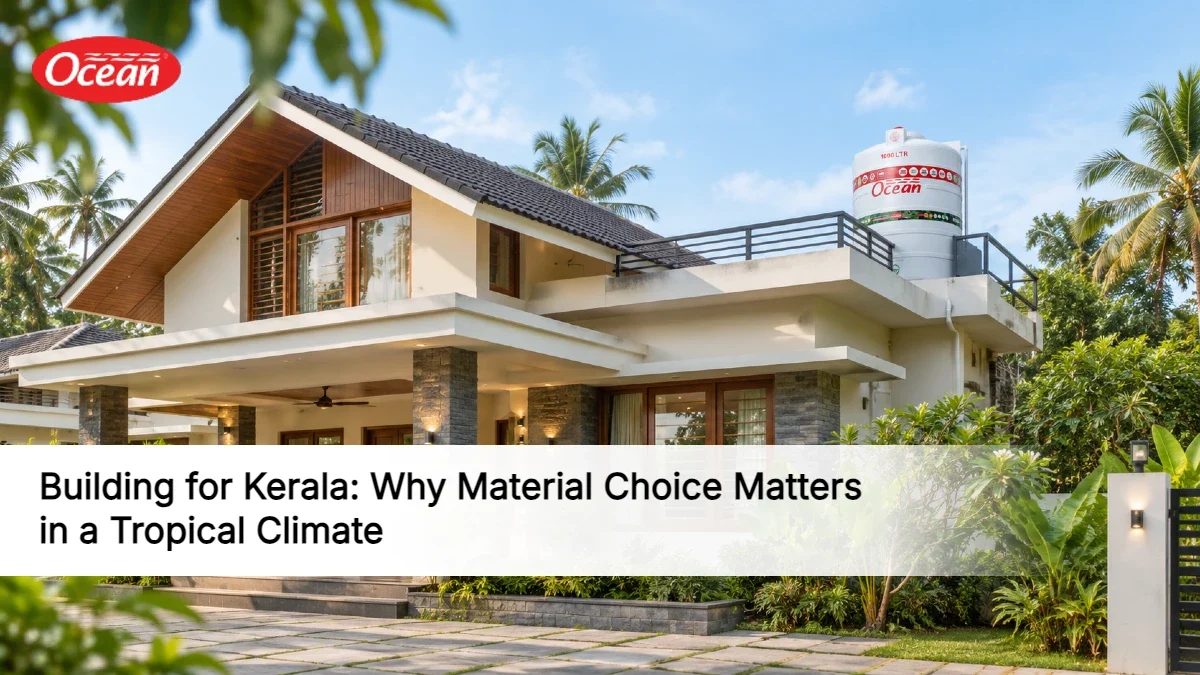
Building in Kerala comes with a unique set of environmental considerations. High humidity, intense sunlight, heavy monsoon rainfall, coastal exposure in many regions, and significant temperature variations can all influence how a building performs over time. A material that works well in a dry or temperate climate may not necessarily deliver the same performance in Kerala.
This is why material selection matters from the very beginning of a project. From the structure and roofing to water storage, piping, flooring, doors, windows, and finishing materials, every component needs to be considered in relation to the local climate. Choosing materials suited to Kerala’s tropical conditions can help improve durability, reduce maintenance requirements, and support better long-term performance.
What Makes Kerala’s Climate Challenging for Buildings?
Kerala experiences a tropical climate characterised by high humidity, substantial rainfall, and warm temperatures for much of the year. The state receives two monsoon seasons, with the southwest monsoon bringing particularly heavy rainfall across much of the region.
For buildings, this means prolonged exposure to moisture is a normal part of the environment rather than an occasional challenge. Materials can face repeated wetting and drying cycles, strong sunlight, biological growth, corrosion, and changes in temperature and humidity.
Coastal areas can face an additional challenge from salt-laden air, while regions with intense summer exposure may place greater demands on exterior materials.
A well-designed building therefore needs materials that are selected not only for appearance or initial cost but also for how they are expected to perform under local environmental conditions.
Why Material Selection Should Begin With the Climate
The same building material can behave differently depending on where it is used. A product installed in a relatively dry environment may have very different exposure conditions from one used in a humid tropical region.
In Kerala, material selection should take factors such as moisture resistance, UV exposure, temperature, corrosion, maintenance, and expected lifespan into account.
For example, a material exposed continuously to rain and humidity needs to manage moisture effectively. A product installed outdoors needs sufficient resistance to prolonged sunlight. Materials used around water need to be suitable for prolonged contact with moisture without deteriorating prematurely.
Thinking about these conditions before construction begins can prevent avoidable maintenance problems later.
Moisture Resistance Is a Major Consideration
Water is one of the most important environmental factors affecting buildings in Kerala.
Persistent humidity and heavy rainfall can expose building materials to moisture for extended periods. Poorly selected or poorly protected materials can absorb water, develop surface deterioration, encourage biological growth, or experience corrosion depending on their composition and application.
This is particularly relevant for areas such as roofs, external walls, bathrooms, balconies, foundations, water-storage areas, and drainage systems.
Materials with appropriate moisture resistance can help reduce the impact of repeated exposure. However, material selection should always work alongside proper waterproofing, drainage, ventilation, and installation practices. No single material can compensate for poor construction detailing.
Humidity Changes the Way Materials Perform
High humidity affects more than just how a building feels indoors. It can influence the performance and maintenance requirements of several building components.
Wood, metals, plastics, coatings, adhesives, and other materials can respond differently to prolonged exposure to moisture. Some may expand or contract, some can corrode, while others may become vulnerable to mould or surface deterioration if the surrounding conditions allow moisture to remain trapped.
This makes ventilation and material compatibility particularly important in Kerala homes and buildings.
Choosing materials designed for the intended environment, while ensuring adequate ventilation and drainage, can help reduce the effects of prolonged humidity.
UV Resistance Matters Too
Kerala’s tropical climate is not defined by rain alone. Between periods of rainfall, building materials can also experience strong sunlight and prolonged ultraviolet exposure.
Outdoor products that are not adequately protected against UV radiation may gradually fade, become brittle, lose surface strength, or deteriorate over time depending on their composition and application.
This is particularly relevant for products such as water tanks, roofing components, outdoor furniture, pipes, exterior finishes, and other materials that remain exposed to sunlight throughout the year.
UV-stabilised materials can offer greater resistance to this form of environmental stress, helping products retain their intended performance for longer.
The Monsoon Makes Durability Even More Important
Kerala’s monsoon is a major consideration in almost every construction project.
Heavy and prolonged rainfall can place pressure on roofs, drainage systems, external surfaces, foundations, water-storage structures, and other building components. Poor drainage can also leave materials exposed to standing water for extended periods.
This is why durability should not be viewed simply as the ability of a material to withstand everyday use. In Kerala, durability also means being able to cope with repeated cycles of intense rain, high humidity, drying, and sunlight.
A building designed with these conditions in mind is better positioned to maintain its performance through successive monsoon seasons.
Corrosion Is Another Factor to Consider
Metal components can be particularly vulnerable to corrosion in humid environments, and the risk can be more pronounced in coastal areas where salt in the atmosphere can accelerate corrosion.
This does not mean metal cannot be used effectively in Kerala. Rather, it highlights the importance of selecting the right grade, protective treatment, coating, and application for the environment.
For components exposed to moisture, appropriate corrosion-resistant materials and protective measures can help extend service life and reduce maintenance requirements.
The same principle applies across construction: the right material is not necessarily the one that performs well in isolation, but the one suited to its specific environment and intended use.
Water Storage Needs Climate-Specific Materials
Water storage is an important part of any building, particularly in areas where water supply may vary seasonally or where households and institutions require stored water for everyday use.
A water tank installed in Kerala may remain exposed to intense sunlight, heavy rain, humidity, and temperature fluctuations throughout the year. Material quality therefore has a direct bearing on long-term performance.
Food-grade, UV-stabilised materials can help support safe and durable water storage in tropical conditions. Proper construction also matters, particularly when a tank is expected to remain outdoors for many years.
Ocean Group manufactures water-storage solutions using one hundred per cent virgin, food-grade raw material and advanced roto-moulding technology. Its ISI-certified range includes overhead, underground, loft, capsule, and vertical sump tanks, providing different configurations for residential, commercial, and infrastructure requirements.
With more than 27 years of experience in water storage and polymer solutions, Ocean Group’s products are designed with the demands of Indian conditions in mind.
Polymer Materials Have a Growing Role in Modern Construction
The use of polymer-based products in construction has expanded as builders and manufacturers look for materials that combine durability, versatility, and practical performance.
Polymer products can be used across a range of applications, including water storage, piping, industrial systems, sanitation infrastructure, and other construction-related requirements.
One example is Wood Plastic Composite, or WPC, which combines wood-based material with polymer to create products suitable for applications where resistance to moisture and environmental exposure is important.
Ocean Lykewood, Ocean Group’s WPC range, is developed for modern construction and design applications where durability and moisture resistance are important considerations.
The growing use of such materials reflects a broader shift in construction towards selecting products based on their performance in the environment where they will actually be used.
Material Choice Can Influence Maintenance
Construction decisions made at the beginning of a project can influence maintenance requirements for years afterwards.
A material that deteriorates quickly under local conditions may require frequent repainting, replacement, repairs, or protective treatment. A material better suited to the climate may reduce some of these requirements, although regular maintenance will always remain necessary.
This is particularly important for buildings in Kerala, where moisture, sunlight, and monsoon exposure are recurring environmental conditions rather than occasional events.
The objective should not simply be to choose the most expensive material. It is to choose materials whose performance, lifespan, maintenance requirements, and cost make sense for the intended application.
Choosing Materials for Different Parts of a Building
Different parts of a building experience different environmental conditions, so material selection should be application-specific.
Roofs and External Surfaces
Roofs and external walls receive direct exposure to rain and sunlight. Materials and protective systems should therefore be selected for weather resistance, thermal performance, and long-term durability.
Water Storage
Tanks require materials suitable for prolonged exposure to water, sunlight, and changing temperatures. Food-grade and UV-stabilised materials are particularly relevant where stored water is intended for household use.
Plumbing and Water Supply
Pipes and fittings need to withstand continuous water exposure and the pressure conditions associated with their intended application. Correct sizing, installation, and material selection all contribute to reliable performance.
Doors, Windows, and Interior Components
Humidity can influence materials used indoors as well. Moisture-resistant finishes and suitable ventilation can help minimise deterioration in areas such as kitchens, bathrooms, and utility spaces.
Industrial and Infrastructure Applications
Industrial environments can introduce additional requirements, including chemical exposure, mechanical stress, temperature variations, and continuous operation. Materials should therefore be selected according to the specific operating conditions rather than simply general climate.
Sustainability Is Becoming Part of Material Selection
Material choice is increasingly connected to the broader question of sustainability.
A product that lasts longer may reduce the frequency with which it needs to be replaced. Materials that can be used efficiently, require less maintenance, or support recycling and reuse can also contribute to more responsible construction practices, depending on their manufacturing and end-of-life characteristics.
For Kerala, where buildings need to withstand recurring environmental exposure, durability itself can be an important part of a more sustainable approach. Selecting appropriate materials at the design stage can help avoid premature replacement and unnecessary resource consumption.
Build for Kerala, Not Just in Kerala
A successful building is not simply one that looks good when construction is complete. It is one that continues to perform as the years pass.
In Kerala, that means accounting for the climate at every stage, from the foundation and drainage system to the roof, water storage, piping, finishes, and external components.
Material choice should therefore be based on more than appearance or initial price. Moisture resistance, UV stability, corrosion resistance, durability, hygiene, application requirements, maintenance, and expected lifespan all deserve consideration.
Ocean Group’s experience in water storage and polymer solutions reflects this same principle. With more than 27 years of manufacturing experience, the company develops products for applications where durability, reliability, and suitability for Indian conditions matter.
The future of construction in Kerala will not simply be about building more. It will be about building in ways that respond more intelligently to the environment.
When materials are chosen for the climate, buildings are better prepared for the years ahead.
Frequently Asked Questions
-
Why is material selection important for buildings in Kerala?
Kerala’s high humidity, heavy monsoon rainfall, strong sunlight, and coastal conditions in many areas can place additional demands on building materials. Selecting materials suited to these conditions can support durability and reduce avoidable maintenance.
-
What materials are suitable for Kerala’s tropical climate?
There is no single material that is suitable for every application. The right choice depends on where the material is being used and its exposure to moisture, sunlight, corrosion, temperature changes, and mechanical stress. Moisture-resistant, UV-stabilised, corrosion-resistant, and application-specific materials can be useful in appropriate situations.
-
Why is UV resistance important in Kerala?
Outdoor materials can receive prolonged exposure to ultraviolet radiation from sunlight. UV-stabilised materials are designed to better withstand this exposure and can help reduce premature deterioration in suitable applications.
-
Are plastic water tanks suitable for Kerala’s climate?
High-quality water tanks made from appropriate food-grade and UV-stabilised materials can be suitable for Kerala’s climate. Product construction, material quality, installation, and maintenance also play important roles in long-term performance.
-
Does humidity affect building materials?
Yes. Prolonged humidity can contribute to corrosion, biological growth, moisture-related deterioration, and dimensional changes in certain materials. Proper material selection, ventilation, waterproofing, and drainage can help manage these risks.
-
Why are polymer products being used more widely in construction?
Polymer-based products can offer a combination of durability, versatility, moisture resistance, and application-specific performance. They are used across areas such as water storage, piping, industrial products, sanitation, and WPC applications.