

Kerala’s monsoons are no joke. Between the heavy humidity, the seasonal flooding, and the constant threat of termites, traditional wood door and window frames often don’t hold up. That’s why more homeowners, contractors, and interior designers across the state are switching to WPC (Wood Plastic Composite) frames for new builds and renovations.
But not all WPC frames are the same. As demand grows, so does the number of WPC brands in Kerala competing for attention, and quality can vary a lot between them. The real difference lies beneath the surface, in the material quality and manufacturing standards that decide how well a WPC frame performs over time.
What Is a WPC Frame?
A WPC frame is made by combining wood fibers with plastic (like PVC or PP), along with bonding agents that fuse the two materials into a dense, solid composite. The result looks and feels like wood but behaves very differently when it’s exposed to moisture, pests, or temperature changes.
Unlike solid wood, WPC has no grain lines, knots, or natural gaps where water or insects can get in. This makes it a practical choice for Kerala’s climate, where humidity regularly crosses 80% during the monsoon months.
Key Signs of a High-Quality WPC Frame
Not every WPC frame performs the same. Here’s what actually separates a well-made frame from a poor one.
Density and Core Quality : A good WPC frame has a dense, solid core with no air pockets or uneven filler inside. Lower-density frames may look the same from outside but tend to sag, crack, or lose shape faster under weight. If possible, ask the supplier for the frame’s density rating (usually measured in kg/m³) — a good manufacturer will share this without hesitation.
Moisture and Termite Resistance : This is the main reason people switch to WPC in the first place. A genuinely good frame should absorb almost no water even after 24 hours in water, and it should have test reports confirming termite and borer resistance. If a supplier can’t answer basic questions about moisture testing, that’s a red flag.
Surface Finish : Run your hand across the frame’s surface. It should feel smooth and even, with no bubbling, peeling edges, or visible seams. Poor surface finish is usually the first thing to fail, often within a year or two, especially in areas with direct sun or constant moisture like bathroom doors or entryways.
Shape Stability : A good WPC frame holds its exact shape and size no matter how humidity changes, instead of expanding, shrinking, or warping. It shouldn’t swell during the monsoon or crack during Kerala’s drier months. If a frame shows even slight warping in a showroom sample, it will likely get worse after installation.
Strength and Hinge Grip : Frames need to hold the weight of the door and handle daily opening and closing. Good WPC frames keep a strong grip on screws and hinges over time, without the material crumbling or loosening around fittings — a common problem with low-grade composites.
Certifications and Testing : Reliable manufacturers test their products against standard benchmarks, including relevant IS (Indian Standard) codes and sometimes ISO certification for their manufacturing process. WPC-specific IS codes are still developing in India, but a manufacturer that tests density, water absorption, and fire resistance on its own, and holds ISO certification, shows a stronger commitment to quality than one with no data or certification at all. Ocean Lykewood is part of an ISO-certified organization that follows established quality control processes to maintain consistency, durability, and product performance.
WPC Frames vs Traditional Wood Frames
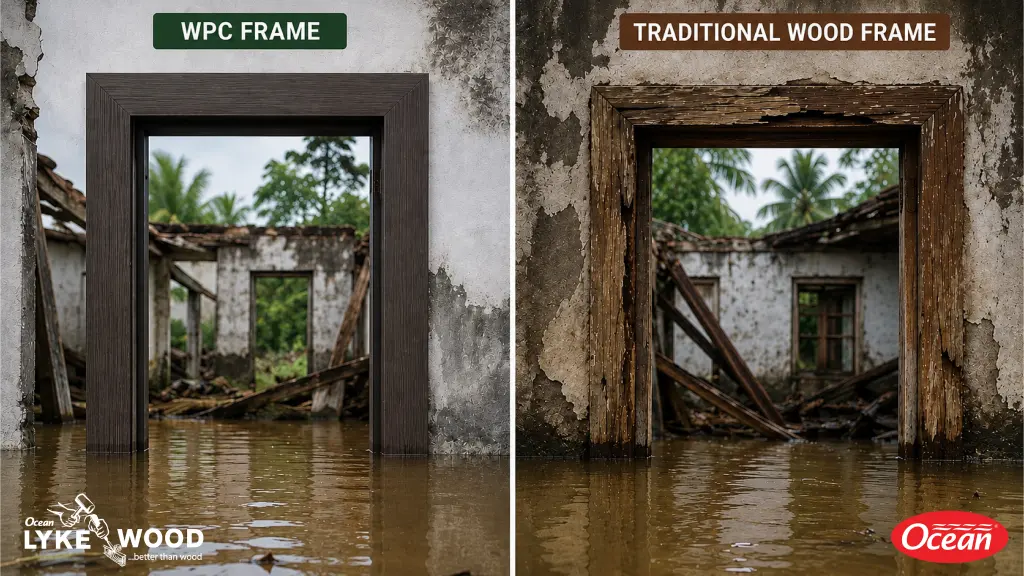
| Factor | WPC Frames | Traditional Wood Frames |
| Moisture resistance | High — minimal water absorption | Low to moderate — prone to swelling |
| Termite resistance | Very high | Requires chemical treatment |
| Maintenance | Low | Moderate to high |
| Dimensional stability | High | Variable, depends on wood type |
| Initial cost | Slightly higher upfront | Often lower for basic wood species |
| Long-term cost | Lower due to reduced repairs | Higher due to repainting/repairs |
For Kerala, the moisture and termite resistance points matter the most. Many homeowners who first chose wood for its familiar look end up spending more over five to ten years on repairs, repainting, and pest treatment than they would have spent on a good WPC frame upfront.
How to Find a Reliable WPC Brand in Kerala
With so many WPC brands in Kerala to choose from, from big names to newer, lesser-known ones, it helps to have a simple checklist before you buy.
How do you check WPC frame quality before buying? Ask for a physical sample, check the density and water-absorption numbers, and get the warranty terms in writing before placing an order.
A few practical steps to narrow down your options:
- Ask for a physical sample and test it yourself. Leave it in water overnight if needed to check for swelling.
- Compare the WPC frame price in Kerala across at least three suppliers. Unusually cheap pricing is often a sign of lower-quality filler material.
- Check for local dealer support and after-sales service. A brand with an active local presence is easier to hold accountable if something goes wrong.
- Look for a warranty of at least 10 to 15 years covering structural defects, moisture damage, and termite issues.
- Read real customer reviews, and if possible, visit a finished installation instead of relying only on showroom samples.
- Ask about installation support. Good brands usually work with trained installers or give clear fitting guidelines, which matters a lot for how long the frame lasts.
Among the better WPC frame manufacturers, the ones worth shortlisting are usually open about their testing process and willing to put warranty terms in writing, not just verbal promises at the time of sale. Brands like Ocean Lykewood, for example, have built a name in the Kerala market around this kind of openness. Ocean Lykewood is an ISO-certified manufacturer.
Installation and Maintenance Tips
Even a good frame won’t perform well if it’s installed poorly. A few things to keep in mind:
- Make sure the wall opening is properly leveled before fitting. Uneven walls put stress on the frame over time.
- Use the fasteners recommended by the manufacturer instead of generic screws, since this affects how long the hinges hold up.
- Seal all edges and joints properly, especially where the frame meets the floor, to stop water from pooling during heavy rain.
- For upkeep, wiping it down with a damp cloth is usually enough. Avoid harsh chemical cleaners that can dull the finish.
- Check hinges and fittings for tightness now and then, especially on doors used often.
Get This Right the First Time
Choosing a WPC frame comes down to looking past the surface and asking the right questions about density, moisture testing, warranty terms, and installation support. With so many WPC brands in Kerala competing on price alone, taking a little time to compare real product data will save you a lot more in the long run than just going with the cheapest option.
Your doors and windows have to survive Kerala’s monsoons, so it’s worth getting this decision right the first time. Ready to see the difference for yourself? Reach out to Ocean Lykewood
FAQs
-
What is the lifespan of a good WPC door frame?
A well-made WPC frame usually lasts 15 to 25 years or more with little maintenance, depending on installation quality and how it’s used. Frames exposed to constant moisture, like bathroom doors, may last on the lower end of that range.
-
Are WPC frames better than wooden frames for Kerala’s climate?
For Kerala’s humidity and monsoon rains, WPC frames generally do better than wood in moisture resistance, termite protection, and shape stability. Wood can still work well if you want a natural look, as long as it’s properly treated and maintained.
-
How much does a quality WPC frame cost compared to wood?
WPC frames usually cost a bit more upfront than basic wood, though price depends on brand, size, and finish. Over time, WPC often works out cheaper because of lower repair, repainting, and pest-treatment costs.
-
Can WPC frames be painted or polished like wood?
Yes, most WPC frames can be painted or polished, though the process is a little different from wood. Many brands also offer pre-finished options so you don’t need to paint at all.
-
Do WPC frames need any special care?
Not really. A damp cloth for cleaning and occasional hinge checks are enough. Unlike wood, WPC frames don’t need sanding, repainting, or termite treatment.